
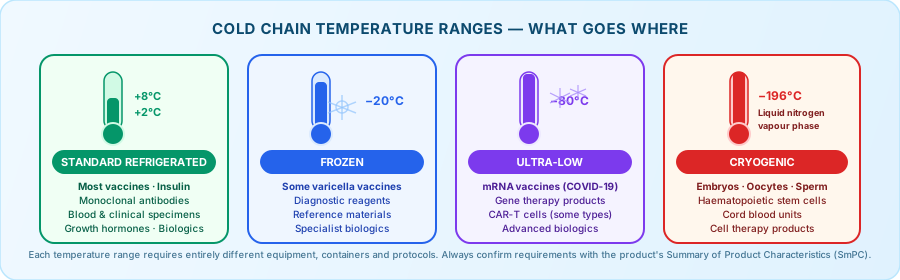
Cold chain means keeping a medicine inside its validated temperature range for every minute between leaving the manufacturer and reaching the patient, with a record proving it. There are four ranges in practice, from ambient down to −80°C, and they need entirely different equipment rather than the same box set colder. A single excursion can render a consignment unusable even though nothing about it looks different. We carry vaccines, biologics and clinical trial material across all four, with the data logger record to show for it.
What Is Cold Chain — And Why Does It Matter?
Cold chain isn't a term you hear much outside the industry, but it's worth understanding — especially if you're relying on a pharmaceutical product to work when it reaches you.
It means what it sounds like: an unbroken sequence of temperature-controlled storage and handling from the moment a product leaves the manufacturer to the moment it's administered. No warm gaps. No unexpected freezes. No "it'll be fine for a couple of hours." The chain holds, or it doesn't.
In practice, it breaks more often than it should. A courier using an uncalibrated cool box. A refrigerator at a GP surgery running a few degrees warm. A vaccine sitting in a van while the driver makes three other deliveries. Any one of these can compromise a product that looks completely normal from the outside — the vial is intact, the colour is right, the label says the right thing. But the biological activity has gone.
For most medicines, a substandard cold chain is an inconvenience. For biologics — complex molecular products whose activity depends on their three-dimensional structure — it can mean the treatment doesn't work at all. For a gene therapy product priced at six figures a dose, or a personalised CAR-T cell product, "it probably survived" isn't an acceptable standard.
+2°C to +8°C (standard refrigerated) — for most vaccines, insulin, many biologics. −20°C (frozen) — for certain vaccines including some varicella formulations, some diagnostic reagents and biological reference materials. −80°C (ultra-low) — for mRNA vaccines and many advanced biologics. −196°C (cryogenic) — for cell and gene therapy products, stem cells. Each range requires entirely different equipment and protocols.
Temperature Ranges Explained: Not All Cold Is the Same
"Cold" is not one thing. The temperature requirements across the pharmaceutical and biological spectrum cover more than 200°C, and the equipment, packaging, and procedures for each range are entirely different. A service that handles standard +2–8°C refrigerated pharmaceutical transport is not set up for −80°C ultra-low work, and certainly not for −196°C cryogenic. Different equipment. Different training. Different consequences when things go wrong.
Standard Refrigerated (+2°C to +8°C)
The standard refrigerated band is where most conventional vaccines sit — influenza, hepatitis, meningitis, HPV, pneumococcal, MMR. Most monoclonal antibodies (adalimumab, trastuzumab, rituximab and others) also need +2–8°C. Add insulin, human albumin, and a broad range of biological research materials and diagnostic reagents, and you've got the most frequently requested cold chain specification in our work.
Maintaining +2–8°C during transport requires validated passive packaging (insulated box with phase-change ice packs, demonstrated through temperature mapping to hold the required range under expected environmental conditions) or an active refrigerated transport unit. Both work, but both need documented validation. A domestic cool box from a supermarket does not meet this standard — and we've had calls from practices that have used one, so this isn't hypothetical.
Frozen (−20°C)
Some vaccine formulations and a range of biological materials require storage at −15°C to −20°C. In the UK, the varicella vaccine Varivax must be stored and transported at ≤−15°C. Various diagnostic reagents, biological reference standards, and certain pharmaceutical products also require this range.
One thing worth flagging explicitly: the UK-licensed MMR vaccines — M-M-RvaxPRO and Priorix — store at +2–8°C, not frozen. This is a surprisingly common point of confusion. Always check the product-specific SmPC rather than assuming. And equally: products specified at −20°C must not go colder. Exposing them to −80°C dry ice conditions or liquid nitrogen takes them well outside specification.
Ultra-Low (−80°C)
The −80°C range became widely known during the Covid pandemic when Pfizer-BioNTech's mRNA vaccine required −70°C to −80°C storage. Before Covid, this temperature range was already established for many advanced biologics and research materials — it's now more routinely encountered in general pharmaceutical logistics than it was five years ago.
Transport at −80°C uses dry ice (which sublimes at −78.5°C) in validated insulated packaging. Dry ice is classified under IATA as a dangerous good; air transport requires compliance with IATA PI 954. All our couriers hold current IATA DG training covering dry ice.
Cryogenic (−196°C)
The −196°C range — maintained in liquid nitrogen vapour inside a dry shipper — is required for cell and gene therapy products, haematopoietic stem cells, cord blood, embryos, and other cryopreserved biological materials. There's no overlap with standard cold chain logistics. The equipment is different, the training is different, and the consequences of a temperature breach are different — as we cover in detail in our articles on stem cell transport and embryo transport.
What Are Biologics — And Why Are They So Temperature-Sensitive?
"Biologics" covers medicines derived from or produced using living organisms — large proteins, nucleic acids, or living cells — rather than small molecules built by conventional chemistry. The category runs from conventional vaccines and blood products through to monoclonal antibodies, and at the most advanced end, gene and cell therapies.
They're temperature-sensitive because their activity depends on structural integrity. A large protein like a monoclonal antibody holds its three-dimensional shape through relatively weak molecular forces — heat disrupts those forces, causing unfolding and loss of activity. Freezing can cause ice crystal formation and aggregation. A biologic outside its temperature specification may look identical to a conforming vial. The damage is molecular, invisible, and not recoverable.
Monoclonal Antibodies
mAbs — trastuzumab (Herceptin), pembrolizumab (Keytruda), adalimumab (Humira), rituximab (MabThera) — are among the most-used oncology and immunology medicines we transport. They all need +2–8°C and must not be frozen. A single freeze-thaw cycle causes aggregation that may be visible or invisible in the vial, but either way compromises activity. They must not be shaken. They must not be exposed to prolonged light.
I've seen a courier deliver a trastuzumab infusion bag packed with frozen gel packs in an uncalibrated box. The temperature log on receipt showed the product had dropped below 0°C during transit. The pharmacist caught it — the product wasn't used, the patient's infusion was delayed, and an incident report went in. That's preventable. Validated packaging and properly trained couriers make it preventable.
Gene Therapies
Gene therapy products — Zolgensma for spinal muscular atrophy, Luxturna for inherited retinal dystrophy, and an expanding list of others — are among the most temperature-sensitive and most expensive medicines in existence. Many require −80°C or −196°C transport. List prices can reach hundreds of thousands or millions of pounds per patient, often for a single dose.
A cold chain failure with a gene therapy product isn't just a quality non-conformance. Depending on the product and patient, there may not be a second dose. Some treatment windows are narrow — SMA therapy, for example, is most effective in early infancy. For these products, the cold chain isn't background infrastructure. It's clinically critical.
Immunotherapies and CAR-T Cell Products
CAR-T cell products are personalised cancer treatments made from the patient's own T-cells — extracted, genetically modified at a specialist manufacturing site, and returned. The cells travel in both directions as living biological material at cryogenic temperature. The supply chain often crosses international borders, and the timeline is tight: the patient is typically mid-conditioning chemotherapy, waiting for the cells to come back. If the product is delayed or compromised in transit, the clinical consequences can be severe. This is some of the most demanding logistics work in the biological product sector.
What Happens When Cold Chain Breaks: Real Consequences
Cold chain failures are more common than the official-looking GDP framework might suggest. In routine pharmaceutical distribution, most failures happen not at the courier stage but at local storage — GP fridges running warm, vaccines left out during a busy clinic, restocking that takes too long. Courier-stage failures happen too, and when they do, they're typically harder to detect because the product has moved and the temperature record — if one even exists — may be incomplete.
The insidious part: most cold chain failures are invisible. A vaccine vial that's warmed to room temperature and been re-cooled looks identical to a properly handled one. A mAb that's been frozen and thawed looks the same in the vial. The damage is molecular — protein unfolding, reduction in viral vector titre, loss of cell membrane integrity — and it's not detectable by visual inspection. Only a validated, continuous temperature record gives you the product's actual history. Without it, "it looked fine" is the only defence. Which isn't a defence.
The patient consequences depend on the product. An inadequately handled vaccine offers reduced or no protection; the patient believes they're immunised, the prescriber believes they're immunised, and neither knows otherwise until an exposure event. A compromised biologic may fail to suppress a patient's cancer or autoimmune disease. For a gene therapy or personalised cell product, a cold chain failure can mean the treatment can't be used, the patient's treatment window has passed, or there's no replacement dose available.
One of the most dangerous aspects of a cold chain failure is that the product often shows no visible signs of damage. A vial of vaccine that has warmed to room temperature and then been re-cooled looks identical to a properly handled vial. Only validated temperature monitoring with a continuous data record gives you confidence that the cold chain was maintained. Couriers who cannot provide this assurance should not be handling your temperature-sensitive biological products.
GDP Compliance: What It Is and Why It Matters
Good Distribution Practice — GDP — is the quality framework that governs how medicinal products should be stored, handled, and distributed. In the UK, GDP guidelines are issued by the MHRA and follow the structure of the EU guidelines (2013/C 68/01), which UK standards remain closely aligned with post-Brexit.
In practical terms, GDP is about being able to demonstrate, through documentation, that a product's distribution history meets defined standards. The key requirements covering courier operations include:
- Quality management: A documented quality management system, with clear responsibilities, procedures and records — not just on paper, but actually followed.
- Personnel training: Everyone handling medicinal products has received appropriate GDP training, with records to prove it.
- Equipment validation: Validated storage and transport equipment with documented temperature mapping and calibration certificates — not assumptions, but data.
- Complete documentation: Unbroken records for all movements of medicinal products — temperature logs, chain of custody, proof of receipt.
- Transport procedures: Documented, validated procedures for temperature-controlled transport, including route risk assessments and contingency plans.
- Incident management: Procedures for investigating temperature excursions, complaints, and suspected quality issues — with corrective action follow-through.
The documentation requirement is what matters most in practice: if there's no contemporaneous record, it didn't happen. Regulators don't accept verbal assurances, and neither do the clients we work for. Our operations are GDP-aligned and ISO 9001-aligned — documented and available for review.
UK Post-Brexit Cold Chain Regulations
Brexit has added regulatory complexity to UK-EU pharmaceutical distribution that didn't previously exist. If you're moving biological products across that border, it's worth understanding what's actually changed — and what the practical implications are for your cold chain planning.
The UK now operates under UK GDP guidelines. These are very similar to EU GDP in substance, but they're distinct regulatory instruments, and UK Wholesale Dealer Licences issued by the MHRA are not automatically recognised by EU competent authorities for distribution into EU member states. If you're distributing a UK-manufactured biological product into the EU, or receiving EU products in the UK, you may need licences and Qualified Person oversight in both jurisdictions. This isn't a minor paperwork issue — it affects how products can be moved and who can release them.
For batch release: UK importers of EU-manufactured medicinal products now need UK batch testing by an MHRA-licensed QC lab, unless a specific Mutual Recognition arrangement applies. This adds time and logistics steps that need to be built into cold chain planning. Products can't just cross the Channel in a validated cool box without a paper trail that satisfies both regulators.
For clinical trials, the UK remains willing to facilitate cross-border collaboration, but IMPs travelling between UK and EU trial sites need to comply with both frameworks. Talk to your regulatory affairs team — and then talk to your courier — before assuming a cross-Channel IMP supply chain is straightforward. It usually isn't.
Clinical Trials Logistics: A Specialist Cold Chain Challenge
Clinical trial supply chains are some of the most demanding cold chain work we do. IMPs — investigational medicinal products — are often produced in limited quantities at significant cost, and their temperature specifications may not yet be fully validated through stability studies. Every dose matters in a way that commercial products don't: if you lose a commercial vial, you reorder; if you lose a Phase I IMP dose, there may not be another available for months.
The documentation requirements for IMP transport are also more stringent than for commercial products, because the data generated during a trial needs to withstand regulatory audit. Temperature logs need to be continuous and calibrated, with the logger's certificate appended. Chain of custody documentation needs to record every handover with timestamps. Anything less, and you have a protocol deviation on your hands.
For phase I and II trials with small patient numbers, the product supply is often so limited that a single compromised dose can affect the trial timeline. For biologic and cell therapy trials, the temperature requirements are frequently as demanding as for any licensed medicine — sometimes more so, given that the IMP may not have been through formal excursion stability testing yet. You don't have the safety data that would tell you whether a brief temperature deviation matters. That means you have to assume it does.
We work with clinical trial sponsors, CROs, and site teams across the UK and into Europe. Our documentation meets ICH requirements and MHRA inspection standards. If you're setting up a new trial supply chain, talk to us early — ideally at protocol development stage, not after site initiation.
Hospital-to-Hospital Transport of Biological Medicines
Hospital-to-hospital biological medicine transport is one of those areas where the need exists regularly, but the infrastructure often doesn't. NHS pharmacy teams are stretched. Clinical coordinators aren't logistics specialists. And yet the situations that require urgent inter-hospital biological product transfer come up constantly:
- Surplus vaccine redistribution: A GP surgery or hospital has vaccines nearing expiry that a neighbouring site needs urgently. Same-day cold chain transfer prevents waste and covers patient need.
- Biologic medicine transfers: A patient transferred between hospitals mid-course of treatment needs their next biologic dose to follow them, under maintained cold chain conditions.
- Emergency biological supply: A pharmacy runs short of a critical biologic on a Friday afternoon. The nearest supply is 40 miles away. This needs a same-day cold chain courier, not a general parcel delivery.
- Clinical trial site transfers: IMP stock being moved between trial sites when a site closes, or surplus reallocated — must be handled under GDP conditions with full documentation.
All of these need a specialist cold chain courier with the right packaging, the right documentation, and the availability to respond quickly. We handle all of these scenarios across NHS hospitals, private hospitals, pharmacy groups, and clinical trial sites throughout the UK.
Who Needs a Cold Chain Courier Service?
The straightforward answer: if your product has a temperature specification and needs to travel, you need a specialist cold chain courier. The less obvious answer: the organisations that actually use us span a wider range than most people expect.
- GP surgeries and primary care networks: Urgent vaccine supplies, surplus stock redistribution, and same-day restocking when the fridge supply runs short.
- NHS hospitals and integrated care boards: Inter-hospital biological medicine transfers, clinical trial IMP supply, and vaccine distribution within systems.
- Private hospitals and clinics: Biologic infusion medicines, specialist vaccines, and personalised medicine products — often on short notice.
- Pharmaceutical companies: Distribution of biological products to wholesalers, hospitals, and dispensing pharmacies, with GDP-compliant documentation.
- Clinical trial sponsors and CROs: IMP supply chain management across multi-site UK and European trials.
- Biotech companies: Transport of research biologics, development-stage products, and reference materials — often before the commercial supply chain is established.
- Diagnostic laboratories: Temperature-sensitive reagents, quality control materials, calibration standards, and proficiency testing samples.
- Home infusion pharmacies: Biological medicines dispensed directly to patients at home, where the cold chain must extend all the way to the patient's door.
Documentation Requirements for Cold Chain Pharmaceutical Transport
Documentation for cold chain pharmaceutical transport under GDP is not optional. It's one of the practical areas where using a proper specialist courier versus a general delivery service makes a real, auditable difference. Here's what's required for every transport:
- Continuous temperature record: An unbroken electronic temperature log covering the full transport duration, with the logger's calibration certificate. Not a one-off reading. Not "we checked it at collection and delivery." Continuous.
- Consignment note: Product description, quantity, batch number, originating site, receiving site, courier identity.
- Chain of custody record: Who handled the consignment at each stage, with timestamps and signatures at every handover.
- Packaging validation evidence: Documented evidence that the packaging used has been validated to maintain the required temperature range under the anticipated environmental conditions. An uncalibrated cool box doesn't meet this requirement.
- GDP training records: Confirmation that the courier handling the consignment has received appropriate GDP training — available on request.
- Incident reports where applicable: If a temperature excursion or other incident occurs, a documented investigation and corrective action record.
For cross-border transport, add: customs declarations, IATA dangerous goods documentation (for dry ice or cryogenic materials), and import/export permits for relevant product categories. We produce all of this for every transport as standard practice.
What to Look for in a Cold Chain Courier for Vaccines and Biologics
Don't choose a cold chain courier on price alone. I understand why it happens — pharmaceutical budgets are tight, procurement teams work from supplier lists, and a box with ice packs looks the same from the outside whether the packaging's been validated or not. But if the product arrives outside temperature specification, the saving on the courier invoice is irrelevant.
Here's what to actually ask:
- Do they provide a continuous calibrated temperature record for every transport? "We use temperature monitors" is not the same as "we provide a calibrated, continuous data log with each consignment, with the instrument certificate."
- What packaging do they use, and is there validation data for it? Ask specifically for the temperature mapping study. If they haven't done one, that's your answer.
- Can they cover all the temperature ranges you might need? +2–8°C is the baseline; −20°C, −80°C, and −196°C require progressively different and more specialised capability.
- Do they hold IATA dangerous goods training? Required for any transport involving dry ice or cryogenic vessels by air — and must be current, not a certificate from five years ago.
- What's their incident management process? What happens the moment a temperature excursion is identified? How quickly are you notified? What documentation is produced?
- Are they available out of hours? Biological medicines don't respect working hours, and neither should your courier.
- Do they have experience with your specific product type? Cold chain for conventional vaccines is operationally different from cold chain for CAR-T products. The experience gap matters.
We can answer all of these with documentation to back it up — ISO 9001-aligned, IATA DG trained, validated packaging systems across all temperature ranges, GDP-aligned quality procedures. Ask us, and we'll send it over.
Embryo Links follows ISO 9001 quality management principles, current IATA dangerous goods training across all relevant categories, and has established GDP-aligned procedures for all temperature ranges from +2–8°C through to −196°C. We provide full temperature documentation for every pharmaceutical and biological transport we undertake.
Frequently Asked Questions About Cold Chain Courier Services
Can you transport vaccines on a bank holiday or weekend?
Yes. For urgent pharmaceutical and biological transports, we operate out of hours including weekends and bank holidays. For planned collections, more notice is better — for urgent situations, WhatsApp is the fastest way to reach us. We don't ask you to leave a voicemail and wait for the next business day.
What happens if your temperature logger shows an excursion during transit?
We notify the consignee immediately, provide the full temperature record, and document the excursion in our quality system with a root cause investigation. The decision on whether to use the product rests with the receiving pharmacist or clinician — that's a clinical and stability data question, not one we answer for them. What we do is give them a complete, accurate temperature record and a straight account of what happened, so they can make an informed decision.
Can you handle −80°C transport for mRNA vaccines or gene therapy products?
Yes. We use validated dry ice packaging systems for −80°C transport, and our couriers hold current IATA dangerous goods certification for dry ice (PI 954). If you have a specific advanced biologic product at this temperature range, contact us to discuss the product, route, and your documentation requirements before booking.
Can you move vaccines and biologics internationally, or only within the UK?
Internationally, and that is most of what we do. The temperature side of a cross-border move is the part people worry about and the part that is actually well understood — a validated container behaves the same in Muscat as it does in Manchester. The part that catches shipments out is authorisation. Every destination has its own health authority, its own import consent, and its own view on who may hold the product on arrival, and those approvals frequently have to name the receiving facility rather than the shipment itself. That paperwork takes longer to assemble than the flight takes to land. Start it the moment the destination is confirmed, not the week you want to travel. The Gulf is the clearest example of how different these layers can be from one border to the next, and we have set that out in detail in our brief on moving cryopreserved material across GCC borders.
Do you serve clinical trial sites across the UK?
Yes, and into Europe. We work with sponsors, CROs, and site teams on IMP supply chains with GDP-aligned documentation that meets ICH requirements. If you're setting up a new trial supply chain, contact us early — at protocol development stage if possible, not after site initiation. The earlier we understand your product and route requirements, the better we can plan for them.
Embryo Links provides specialist cold chain courier services for vaccines, biologics, gene therapies, and all temperature-sensitive pharmaceutical products across the UK, Europe and worldwide. Contact us to discuss your requirements and receive a tailored quote.
Last reviewed: 12 October 2026
Disclaimer: The information provided on embryolinks.com is for general informational and educational purposes only. It does not constitute legal, regulatory, or medical advice. International transport protocols for human tissues and cells are highly subject to change and specific clinic policies. Readers should consult with licensed medical professionals, authorised clinics, and legal advisors before arranging any international biological shipments. Use of this information is strictly at your own risk.