
Clinical specimens are moved under UN3373, which sets how a Category B biological substance has to be packed, labelled and handled in transit. That means compliant triple packaging, a courier trained in what to do if a primary container fails, and a chain of custody that can be reconstructed afterwards. A parcel network cannot offer any of it, because the sample passes through dozens of hands that never know it is a sample. We collect from hospitals, private clinics and GP surgeries and carry the specimen to the laboratory as a single named handover.
Categories of Clinical Specimens: What We Transport and Why Each Is Different
Every day across the UK, thousands of blood tubes, tissue biopsies, urine pots and swabs need to get from GP surgeries, private clinics, hospitals and research units to diagnostic labs. Most of the time it works without incident. But when it doesn't — when a coagulation sample arrives too late to be useful, when a fresh biopsy reaches the path lab at the wrong temperature, when CSF gets refrigerated by someone who didn't know any better — the consequences land on patients. Sometimes that means a repeat test and a delay. In a small number of cases, it means something significantly worse.
We transport all the main clinical specimen types, and each one has its own rules. Below I'll go through them — not as a compliance checklist, but because if you're choosing a clinical courier, you need to know whether they actually understand what they're picking up.
Blood Samples
Blood is easily the most common clinical specimen we handle. Collection tubes come in a variety of types — EDTA purple tops for haem and full blood counts, serum separator tubes (gold or red) for biochemistry, citrate blue tops for coagulation, lithium heparin greens for most biochem panels, and fluoride oxalate greys for glucose. Each tube has its own stability window and temperature requirement. Treating them all the same is exactly where a non-specialist courier falls down.
EDTA blood for an FBC is reasonably forgiving — stable at room temperature for up to 24 hours. Citrate coagulation samples are more fragile; ideally they should reach the lab within four hours of collection, and an INR result won't be reliable if the sample's been sitting in a warm vehicle for six hours. Glucose in fluoride oxalate is more stable because of the glycolysis inhibitor in the tube. Blood cultures are the exception to the "room temperature" rule: they need to stay as close to body temperature as possible, and refrigerating them is a mistake — you'll kill the organisms you're supposed to be growing.
In practice, this means the clinician and the receiving lab need to agree on the pre-analytical conditions — transit time limit, temperature window — and the courier needs to maintain those conditions reliably, with validated containers. Not approximately. Reliably. That's what separates a clinical specimen service from a general courier that happens to accept medical samples.
Serum and Plasma Samples
Many tests are performed on serum (the liquid fraction of blood after clotting, centrifuged from serum separator tubes) or plasma (the liquid fraction with cells removed but clotting factors retained, from heparin or EDTA tubes). Pre-centrifuged samples are transported in the original collection tube, but separated serum or plasma — particularly for specialist tests such as hormone assays, therapeutic drug monitoring, or serological testing — may need to be transported at +2–8°C or even frozen, depending on the analyte and the time to analysis.
Tissue Biopsies and Histopathology Samples
Biopsies are among the most important specimens we handle. A histopath result on a colorectal polyp, a suspicious breast lesion or an endoscopic biopsy determines whether a patient is told their lesion is benign or malignant — and what happens next in their care. Getting the specimen to the path lab properly fixed, correctly labelled, with the request form matching the specimen label, is not optional. Labs will — correctly — reject specimens where the identity can't be confirmed.
Most solid tissue biopsies for routine histopathology go into formalin — 10% neutral buffered formalin — at the point of collection. Formalin-fixed tissue is stable at room temperature for transport. Fixation time matters though: under-fix or over-fix and you affect the quality of staining and immunohistochemistry, including HER2 and PD-L1 testing for cancer pathways. The biopsy needs to arrive at the lab in the fixative, at the right time, with the paperwork matching.
Fresh tissue is a different problem entirely. Intraoperative frozen sections, fresh tissue for cytogenetics, samples going to a research biobank — these aren't in formalin and they're time-critical. They need to travel at +2–8°C, arrive viable, and often arrive within a specific window. I've seen fresh biopsies leave a private surgical suite in central London and arrive at an out-of-town path lab within 90 minutes. That's achievable, but it needs planning upfront — not improvisation on the day.
Urine Samples
MSU for microbiological culture needs to go cold if it can't reach the lab within two hours of collection. Leave it at room temperature and the bacterial count multiplies — you get false positives, uninterpretable results, repeat tests. 24-hour urine collections and specialist assays like protein electrophoresis have different requirements, and it's worth confirming with the receiving lab before booking, particularly for less common tests where the pre-analytical requirements aren't widely known.
Cerebrospinal Fluid (CSF)
CSF is where the stakes are highest. It's collected by lumbar puncture — not a trivial procedure — and it drives some of the most urgent clinical decisions in medicine. Suspected bacterial meningitis. Viral encephalitis. Subarachnoid haemorrhage. The lab needs this sample fast, and the clinical team needs the result even faster.
CSF for microbiology must not go in the fridge. Cells in CSF deteriorate within 30 to 60 minutes, so a delayed delivery doesn't just slow things down — it can destroy the specimen's interpretability. We treat CSF as a priority collection. If you've got a CSF that needs to move, call us directly — not because we want the business, but because this genuinely needs someone who understands what they're handling.
Studies consistently show that pre-analytical errors — mistakes or quality failures before the sample reaches the analyser — account for the majority of laboratory errors in clinical medicine. Transport conditions and transit time are key pre-analytical variables. A laboratory can only produce reliable results from a sample that arrives in good condition.
Why Time Is Critical for Different Sample Types
Not all specimens respond the same way to a two-hour delay. A formalin-fixed biopsy going to histopathology? Stable for days — being an hour late doesn't matter clinically. A routine biochemistry panel on an SST tube? Fine with a same-day service. But CSF from a febrile patient? A blood culture from a suspected sepsis case? A coagulation sample from someone whose warfarin dose is being adjusted? Those delays matter in hours, not days.
Fresh tissue for an intraoperative frozen section needs to arrive while the surgeon is still in theatre — that's the whole clinical point of requesting it. STAT high-sensitivity troponin in a suspected ACS needs to influence a management decision within the hour. A missed collection on a Monday morning means a patient waiting until Tuesday for a result they needed today.
What this means in practice is that a good clinical courier operates in two modes. There's a scheduled service for routine samples — morning bloods from a GP surgery, the daily biopsy run from a private clinic. And there's on-demand same-hour collection for genuine emergencies. A service that only does fixed routes and fixed schedules isn't equipped for the full range of clinical specimen work.
Temperature Requirements for Clinical Specimens
The temperature rules aren't complicated, but getting them wrong is a very common cause of rejected or compromised specimens. Here's a working summary of what different sample types actually need:
- Room temperature (+15–25°C): Most routine blood samples in EDTA, serum separator tubes and lithium heparin. Formalin-fixed tissue biopsies. Swabs in transport medium. Blood cultures (ideally closer to 37°C).
- Refrigerated (+2–8°C): MSU and other urine samples for culture. Pre-centrifuged serum or plasma for biochemistry tests when transit time exceeds 2 hours. Some hormone assays. CSF for biochemistry (but NOT for microbiology). Fresh tissue biopsies not being processed immediately.
- Frozen (−20°C or −80°C): Separated serum or plasma for specialist assays (e.g. stored samples for research, certain virology tests). Some molecular biology samples. Reference samples for quality control.
- Body temperature (~37°C): Blood cultures (if a specialised incubated transport container is available and the transit time is short). Some specialist microbiological samples where organism viability is critical.
It's the requesting clinician or lab's responsibility to specify what they need. It's ours to hit those conditions with validated equipment. A single unvalidated polystyrene box for everything isn't a clinical service — it's a gamble with patient samples.
UN3373 Packaging Requirements: What They Are and Why They Exist
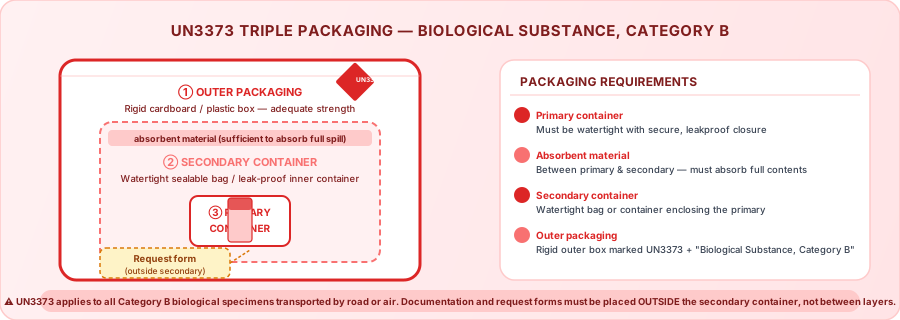
UN3373 is the international classification for Category B biological substances — which covers the vast majority of diagnostic clinical specimens. It applies to road, rail and air transport. If you're sending blood tubes or biopsies anywhere, your packaging needs to meet this standard. No exceptions.
The requirements exist for a practical reason: if the primary container breaks in transit, the contents need to be safely contained rather than creating a biohazard. The solution is a three-layer packaging system:
- Primary container: The actual sample container (tube, vial, pot) — watertight, with a secure closure.
- Secondary container: A watertight, sealable bag or container (such as a zip-lock specimen bag) surrounding the primary container. The secondary container must be able to hold the entire liquid contents of the primary container if it leaks.
- Outer packaging: A rigid outer container of adequate strength for its capacity and intended use — a cardboard or plastic specimen transport box. The outer packaging must be marked with the UN3373 diamond label and the words "Biological Substance, Category B".
Between the primary and secondary containers goes absorbent material — enough to absorb the full volume of the primary container if it leaks. The request form goes outside the secondary container, in a separate document pocket. Not tucked between the layers — that's a detail a lot of practice staff get wrong, and it's a common compliance failure.
We supply UN3373-compliant packaging to all our clinical clients. If your practice staff need a quick refresher on correct technique, we'll walk them through it. It takes about five minutes and it's part of the service, not an extra.
The UN3373 packaging requirements apply to all clinical specimens transported by road, rail, or air in the UK and internationally — regardless of whether the transporting vehicle is a courier car, a van, or an aircraft. A clinical specimen courier who does not provide UN3373 compliant packaging is operating in breach of dangerous goods transport regulations. This matters to you as the sender: if a specimen is incorrectly packaged and causes an incident, the liability may not rest entirely with the courier.
Chain of Custody and Patient Confidentiality: GDPR and Specimen Transport
Clinical specimens aren't just biological material — they carry patient information. Name, NHS number, date of birth, clinical history on the request form. Under UK GDPR and the Data Protection Act 2018, that makes them sensitive personal health data of the most protected category. When we collect specimens from your practice, we're acting as a data processor for your organisation — and we take that seriously.
In practice: we have a Data Processing Agreement available for every healthcare provider we work with. Request forms and patient labels are never left visible in an unattended vehicle. We have a documented breach notification procedure for situations where a specimen is lost or misdirected. In several years of operation that has happened twice — both times the specimen was recovered and the clinical team notified within the hour. These procedures aren't written to satisfy an audit box. They're there because patient confidentiality is a genuine obligation for anyone handling NHS samples.
Chain of Custody for Clinical Specimens
Clinical specimens don't need the dual-witness protocols we use for reproductive material, but they do need a proper collection manifest. Every run gets a documented record: patient identifier, specimen type, collection time, the name of the person handing over the samples, and the time of delivery to the lab, signed off by receiving staff. That's the record that answers "did that sample arrive?" at 5pm on a Friday when a GP needs a result before the weekend.
For labs receiving from multiple collection sites, the manifest is also a useful quality management tool. Patterns of delayed or consistently missing samples from a particular site almost always point to a fixable logistics problem. We flag those patterns proactively rather than waiting for the lab to notice and complain.
How Lab-to-Lab Transport Works in Practice
We run scheduled routes and on-demand collections. The two functions serve different clinical needs and work best when they're both available from the same service.
Scheduled Daily Collections
For GP surgeries, outpatient clinics and smaller hospitals with a consistent daily specimen volume, a fixed collection time each weekday morning is the most efficient arrangement. We time the arrival to coincide with the end of the phlebotomy session — usually between 9:30 and 11am for most practices — so specimens spend the minimum time between collection and starting their journey to the lab.
Most practices running morning phlebotomy sessions can get same-day results for routine biochem and haem with this timing. It's not complicated logistics — it just requires the courier to turn up when they say they will, consistently, every working day.
On-Demand Collections
For urgent or time-critical specimens — STAT coag, a fresh biopsy needing same-day pathology, CSF from a febrile patient at an extended-hours GP — on-demand collection within 60 minutes is available across most UK urban areas. The sample goes point-to-point, direct to the receiving lab. No depots, no consolidation hubs, no sorting. Straight there.
Courier-Assisted Specimen Referrals
Specialist testing — genetics, rare enzyme assays, specialist microbiology, certain endocrinology panels — often runs at reference labs a significant distance from the requesting clinic. For those samples, we're the link between the local lab or clinic and the specialist reference centre. Turnaround is measured in days rather than hours for most of these, but the specimen still needs to arrive in optimal condition. The distance doesn't change the packaging and temperature requirements.
Hospitals vs Private Clinics: Different Needs, Different Solutions
NHS hospitals have internal transport systems — pneumatic tubes, porters, internal sample runs — but there are genuine gaps that external specialist couriers fill. Transfers to external reference labs, urgent samples that need to move faster than internal systems allow, out-of-hours transfers when the internal systems aren't running. We cover those situations.
Private hospitals and clinics often have minimal or no on-site laboratory capacity, which means nearly all their specimens travel externally. For these settings, a reliable specimen courier isn't a supplementary option — it's fundamental. The quality of the lab service delivered to their patients depends directly on how consistently their specimens get to the lab in good condition.
Private fertility clinics sit in their own category. A typical IVF unit might need blood for hormone assays going to a biochem lab, infectious disease screens to virology, semen analysis to andrology, and potentially embryology specimens to or from other units — sometimes all in the same week, each with different temperature requirements and different regulatory considerations. We know this space well.
GP Surgery Specimen Transport: Practical Considerations
Most GP practices rely on NHS pathology network arrangements or contracted couriers for their routine specimens, and that works well in most areas. But there are situations where a dedicated specialist service makes practical sense:
- Practices outside the standard NHS collection route — particularly rural or semi-rural practices where the NHS run arrives late and results don't land until the following day
- Practices needing earlier or more frequent collections than the NHS route provides
- Practices sending specimens to specialist private labs alongside NHS work
- Extended-hours clinics collecting specimens outside the standard NHS window
- Primary care networks with high specialist referral volumes, sending samples to multiple lab destinations
We're not trying to replace NHS courier arrangements where they work. But where there are gaps — in timing, coverage, or the range of labs being served — we can fill them. If any of the above sounds familiar, it's worth a conversation.
Turnaround Time Expectations
Turnaround time for a lab result depends on three things: how quickly the sample gets to the lab, how long it spends in the queue, and how quickly the result is communicated back. We control only the first, but it sets the ceiling for everything else.
For urban and suburban routes with scheduled morning collections, specimens typically reach the lab within two to three hours of collection. Longer routes take up to four. That window gives you same-day results for routine biochem and haem with normal lab turnaround — which is what most practices want from a morning phlebotomy session.
For urgent samples, our on-demand service gets specimens to most UK city labs within 60 to 90 minutes of collection. When timing is really critical — STAT troponin, for instance — we'll call the lab ahead so they can flag it for priority processing on arrival rather than let it join the back of the queue.
How to Set Up a Regular Specimen Collection Service
Setting up a regular service is straightforward. Here's how it typically works:
- Initial consultation: We talk through your specimen volumes, collection times, lab destinations, sample types, and any specific requirements — urgent collections, special temperature needs, multiple lab routes.
- Route planning: We design a collection schedule that integrates your practice into an existing run, or sets up a dedicated collection if your volumes warrant it.
- Documentation setup: We produce collection manifests and GDPR paperwork, and confirm the chain of custody procedure with the receiving lab.
- Packaging provision: We supply UN3373-compliant packaging materials and brief your staff on correct packaging if needed.
- Service commencement: Collections start on the agreed schedule, with a short review period to refine timing and resolve any initial teething issues.
- Ongoing account management: A named contact at our end for queries, schedule changes, and ad hoc urgent requests.
What Makes a Good Clinical Specimen Courier
The clinical specimen courier market ranges from genuinely specialist services — which is what we are — to general same-day couriers who'll accept a specimen bag without knowing what's in it. Here's what distinguishes a proper clinical service:
- UN3373 knowledge: They should be able to describe the three-layer packaging requirement without looking it up. If they can't explain it, they shouldn't be handling clinical specimens.
- Temperature management: They should tell you specifically what containers they use, what temperature ranges those containers maintain, and how long they've been validated for. Not "we use insulated boxes" — which ones? Validated how? For how long in which ambient conditions?
- Collection manifests: A signed manifest at collection and delivery is basic chain-of-custody documentation. Standard, not optional.
- GDPR compliance: They should be operating as a data processor and prepared to sign a DPA. If they've never heard of a Data Processing Agreement, that's a red flag.
- ISO 9001 quality management: Not required, but a documented quality management system tells you their procedures are written down and followed, not just claimed. Ask whether it is independently audited.
- Communication: If a collection is missed or a delivery is delayed, you should hear from the courier — not notice it yourself when results aren't back the next morning.
- Clinical specimen focus: A courier whose core business is biomedical transport is not the same as one that occasionally accepts a sample bag. The understanding of what's in the bag, and what it requires, is genuinely different.
Specimen transport is sometimes treated as a commodity, with the cheapest option chosen without regard to quality. We understand budget pressures in healthcare, and we price our services competitively. But we would encourage clinicians and lab managers to consider the cost of a rejected or compromised specimen — the repeat blood test, the delayed diagnosis, the patient recall — when evaluating whether a specialist service offers value compared to a cheaper general courier.
Frequently Asked Questions About Clinical Specimen Transport
Which couriers accept biological samples, and what makes one suitable?
Most general couriers will not knowingly accept biological samples at all, and the ones that do are often accepting them without realising what they have taken on. The distinction that matters is UN3373. Category B biological substances have to travel in compliant triple packaging, carried by people who have been trained in what to do when a primary container fails, with a chain of custody that can be reconstructed afterwards. A parcel network cannot offer any of that, because the sample is handled by dozens of people who never know it is a sample. Our couriers hold UN3373 qualification, the movement sits inside our ISO 9001 quality management, and the specimen stays with one named person from collection to delivery. When you are assessing anyone for this work, ask who physically holds the sample at each stage, and ask what happens at the point something leaks. The answers separate a specialist from a parcel service very quickly.
Can you collect samples from a GP surgery daily, including Saturdays?
Yes. We can set up regular scheduled collections on any combination of days, including Saturdays, to meet your phlebotomy schedule and your laboratory's cut-off times. Contact us to discuss your specific requirements.
What happens if a specimen is damaged or leaks during transport?
Our UN3373-compliant packaging is designed to contain leaks safely. If a primary container leaks and the secondary packaging contains the specimen, we notify you and the receiving laboratory immediately, document the incident in our quality management system, and advise on whether the remaining sample is sufficient for analysis. Our couriers carry biological spill kits and are trained in how to use them.
We send specimens to multiple laboratories. Can you manage collections for all of them?
Yes. Many of our clients send specimens to multiple lab destinations — an NHS pathology lab for routine tests, a specialist virology lab for serology, a private genetics lab for molecular testing. We coordinate the routing as part of a single service arrangement, so you don't need to manage multiple courier relationships.
Can you transport tissue biopsies that need to stay warm?
Yes. For fresh tissue specimens requiring a specific temperature — body temperature, room temperature, or refrigerated — we have validated containers for each range. We'd want to discuss the specific requirements before collection to confirm we're using the right container for your sample type.
Are you GDPR compliant and can you provide a Data Processing Agreement?
Yes. We operate with full awareness of our obligations as a data processor under UK GDPR and the Data Protection Act 2018. We can provide a Data Processing Agreement as part of our service setup for any healthcare provider whose specimens we transport. Contact us to discuss.
Embryo Links provides specialist clinical specimen transport for GP surgeries, hospitals, private clinics and diagnostic laboratories across the UK. We offer scheduled daily collections, on-demand urgent collections, and bespoke services for specialist specimen types. Contact us today.
Last reviewed: 12 October 2026
Disclaimer: The information provided on embryolinks.com is for general informational and educational purposes only. It does not constitute legal, regulatory, or medical advice. International transport protocols for human tissues and cells are highly subject to change and specific clinic policies. Readers should consult with licensed medical professionals, authorised clinics, and legal advisors before arranging any international biological shipments. Use of this information is strictly at your own risk.