
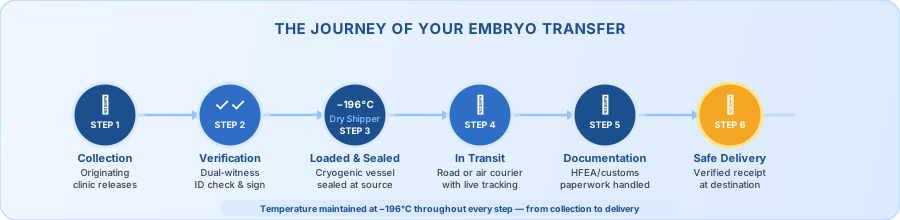
Frozen embryos, eggs and sperm can be moved between clinics and between countries, and it happens every day. The material travels at −196°C in a vapour-phase liquid nitrogen dry shipper, hand-carried in the aircraft cabin by a trained courier, never checked into the hold and never sent as freight. A charged tank holds that temperature for up to 21 days, which is why a delayed flight is an inconvenience rather than an emergency. What actually determines the timeline is the paperwork between the two clinics, not the distance.
What Is Fertility Material Transport — And Why Does It Matter?
It's more common than people realise. Your clinic is in London, but you've decided to pursue treatment in Barcelona. Or you have embryos, eggs or sperm stored at a clinic you no longer want to use, and you need them moved closer to home. Or you're an international patient whose material was created here in the UK and needs to travel abroad for treatment. It happens all the time.
Whatever the reason, the moment you realise your embryos, eggs or sperm need to move is usually a stressful one. These aren't parcels. They're the result of months of hormone injections, egg collections, sperm freezing appointments, IVF cycles — in many cases, years of trying. I've spoken to patients who describe transport day as one of the most anxious of their entire IVF journey. That's completely understandable, and it's why the choice of courier matters.
Fertility material transport means safely moving cryopreserved embryos, eggs or sperm from one clinic to another — whether across a city, across the UK, across Europe, or to the other side of the world. It requires the right cryogenic equipment, careful documentation, regulatory compliance in multiple jurisdictions, and, honestly, a team that understands the weight of what they're carrying.
Embryos, eggs and sperm must be stored and transported at −196°C in liquid nitrogen vapour. Even a brief interruption to this temperature can be catastrophic. A specialist courier is not optional — it is non-negotiable.
Why You Cannot Use a Standard Courier for Embryo, Egg or Sperm Transport
People ask this occasionally. Could a general parcel courier's temperature-controlled service work? Or a regular medical courier? Honestly — no. Not even close. Here's why.
Embryos, eggs and sperm must be kept at −196°C throughout the entire journey. That's the temperature of liquid nitrogen vapour, and maintaining it requires a specialist cryogenic dry shipper — not a cool box, not a refrigerated unit, not a standard medical transport container. A standard courier that offers "temperature-controlled shipping" is maintaining +2–8°C or possibly −20°C. That's not remotely the same thing. At anything warmer than approximately −130°C, cryopreserved material is at risk of devitrification — ice crystal formation that can destroy it.
Beyond equipment, there's the regulatory side. In the UK, the HFEA regulates the storage and transport of all gametes and embryos. Moving embryos, eggs or sperm between licensed clinics requires a formal Third Party Agreement between those clinics, specific documentation, current patient consent, and a documented chain of custody. Standard couriers have none of this infrastructure and aren't licensed to provide it.
For international transfers, IATA regulations add another layer: Category B biological materials must be packaged to Packing Instruction P650, and anyone transporting them by air needs relevant dangerous goods training. Standard couriers aren't trained for this either. If someone offers you fertility material transport without being able to explain these requirements, they're not equipped to do the job.
Under UK regulations, any clinic releasing embryos, eggs or sperm for transport must have a signed Third Party Agreement (TPA) in place with the receiving clinic. A reputable specialist courier will ensure all documentation is coordinated and complete before collection.
How Shipping Frozen Embryos Works — Step by Step
Knowing what happens at each stage makes the whole process less stressful. Here's how a well-managed embryo, egg or sperm transport actually works:
Step 1: Consultation and Planning
It starts with a conversation — between you, the two clinics, and us. We work out the logistics: dates, route, any authorisation needed, what documentation needs to be prepared. For a straightforward UK domestic transfer this might take a week or two. For international transfers — particularly post-Brexit routes between the UK and EU — it can take four to eight weeks, especially if extra HFEA authorisation is needed for the export. Start early. We always tell patients: don't leave international transfers to the last minute.
Step 2: Third-Party Agreements and Documentation
Before any embryo, egg or sperm sample leaves a licensed UK clinic, there needs to be a signed Third Party Agreement between the sending and receiving clinic. This is an HFEA requirement — not paperwork the courier invented. It sets out each clinic's responsibilities and confirms that patient consent is in place. We facilitate this process and check that consents are current. Consent can expire, which is something patients often don't realise until we raise it — so we check, every time, before the transport date is booked.
Step 3: Collection from the Clinic
On collection day, we arrive at the sending clinic with a pre-charged cryogenic dry shipper. The clinic embryologist verifies the identity of the material against the patient records, transfers it into the dry shipper using strict identification protocols, and completes the handover documentation. We use a dual-witness protocol at every collection and delivery — two people independently verify the identity and condition of the sample before anything moves. This isn't optional; it's how good embryology practice works.
Step 4: Transport — In the Cabin, Never in Cargo
Your embryos, eggs or sperm travel in the aircraft cabin with the courier. Not in the hold. This matters for three reasons: the hold is subject to pressure and temperature variations that can affect cryogenic vessels; baggage in the hold passes through X-ray equipment, which fertility specialists generally advise avoiding as a precaution; and cabin carry means the courier has eyes on the dry shipper throughout the entire journey — boarding, in-flight, and on arrival. If anything needs attention, they're right there.
Step 5: Delivery and Handover at the Receiving Clinic
On arrival, the dry shipper goes directly to the receiving embryologist. A second dual-witness verification confirms the identity of the material, the condition of the vessel, and the integrity of the seal. The delivery documentation is signed, the chain of custody is complete, and the sample moves into the receiving clinic's storage. That's the point at which we message you to confirm delivery — and I know from experience that that message makes a significant difference to how the rest of the day feels for most patients.
Step 6: Reporting to You
We send updates at collection, departure, arrival and delivery — via WhatsApp, which most patients find more reassuring than email. You shouldn't spend the day of your transport not knowing where things are. You always know.
The Shipping Container: Understanding Cryogenic Dry Shippers
The equipment matters, and it's worth understanding what you're looking at. Cryogenic dry shippers are specialist vacuum-insulated vessels that maintain −196°C for extended periods without a power source. They look a bit like a thermos flask, except the engineering involved is far more precise — and the consequences of a failure are far more serious.
They're called "dry" shippers because they don't carry free liquid nitrogen. Instead, the inner lining is made of a porous absorbent material that gets soaked in liquid nitrogen before the transport, then slowly releases nitrogen vapour to maintain the ultra-low temperature. This is important for air travel — free liquid nitrogen is prohibited on aircraft, but dry shippers are approved for cabin carry when correctly prepared and documented.
The holding time — how long the vessel maintains safe temperatures — depends on its size and design. We carry an MVE SC 4/3 vapour phase dry shipper, with a validated hold time of up to 21 days. A long-haul transfer uses a fraction of that. The margin is the point: it is what absorbs a cancelled flight or a day lost at customs without the material ever being at risk. A good courier should be able to name the exact vessel model and its tested hold time without looking it up. If they can't, ask why not.
Always ask your courier to confirm the make and model of the dry shipper being used, its tested hold time, and whether it has been pre-charged correctly before collection. At Embryo Links, we use validated, medically certified dry shippers on every transport.
Airport Security and X-Ray: What You Need to Know
Airport security is probably the question I get asked about most often by patients planning a transfer. Will the X-ray scanner harm the embryos, eggs or sperm? The honest answer is that the scientific evidence is limited — there isn't a definitive study showing X-ray exposure at airport scanner doses is harmful to cryopreserved material, but there also isn't one conclusively demonstrating it isn't. Most fertility specialists take the sensible precautionary position: don't put them through the scanner if you can avoid it.
Avoiding the scanner requires preparation. We prepare a full security letter for every journey, explaining what the dry shipper contains and requesting manual inspection. Airport security teams at all major UK and European hubs accommodate manual inspection for medical cargo when the documentation is presented correctly and in advance. Our couriers know exactly how to handle this — it's routine for us, even if it's never routine for the patient.
We have established protocols at Heathrow, Gatwick, Manchester, Amsterdam, Frankfurt, Madrid and Athens, among others. For less frequently used departure airports, we do additional advance preparation to make sure the security team is briefed. We've never had a dry shipper go through an X-ray scanner because security couldn't be managed.
To be plain about where we stand: we do not permit the tank through an X-ray scanner. If manual inspection cannot be secured at a particular airport, the shipment does not travel that day. That decision is made during planning, not argued at the security desk with your embryos sitting on the belt.
International Transport: Regulations and Licences
International transfers are more complex than domestic ones, and that complexity needs to be built into your timeline. Failing to get the right licences in place before the transport date is one of the most common causes of delays — and in the worst cases, a completed transfer plan gets pushed back by weeks because a regulatory step was missed.
Transporting Embryos, Eggs or Sperm Within the European Union
EU Directive 2004/23/EC governs the movement of human tissues and cells — including embryos, eggs and sperm — between EU member states. In principle, material can travel between licensed EU clinics when the appropriate consents are in place. In practice, every country adds its own layer: Spain, Greece, Cyprus and the Czech Republic each have national requirements on top of the EU framework, and "licensed EU clinic to licensed EU clinic" isn't always sufficient. We know what each country needs and build that into the documentation package from the start.
Transporting Embryos, Eggs or Sperm from the UK Post-Brexit
Brexit changed things significantly. UK-created embryos, eggs or sperm being exported to EU clinics now need HFEA authorisation for the export — usually through the standard route once both clinics have met the requirements, occasionally through a case-by-case Special Direction for less straightforward cases — and the receiving EU clinic must comply with the EU's third-country import requirements. This process adds time — typically three to six weeks for the authorisation stage alone. We specialise in UK-EU transport and work directly with clinics to streamline this administrative process. But the planning needs to start early. Don't contact us two weeks before your treatment date if international authorisation is needed. For the fuller picture of how this and other countries' rules work, see our international legal framework guide.
Transporting Embryos, Eggs or Sperm to Other Corridors
We also move material regularly along corridors outside the EU and UK — Iran, Malaysia, Pakistan, China, Indonesia, Tajikistan, the UAE, Oman and others. The requirements vary a lot by country: some route through a Ministry of Health permit, some through general biological-material export rules, and at least one (China) sits under a genuinely strict, actively-enforced approval regime that needs specific confirmation for every shipment rather than a routine box to tick. We keep the specifics current for each route as we book it, and set out what's publicly documented, country by country, in our international legal framework guide.
How to Choose the Right Embryo, Egg or Sperm Courier
Not all fertility material courier services are the same, and it's worth spending time on this decision. Here's what actually matters:
- HFEA knowledge: The courier must understand HFEA requirements and be able to facilitate Third Party Agreement documentation between your clinics. If they've never heard of a TPA, they're not equipped for this work.
- Cabin hand-carry only: Insist on this. If a courier proposes cargo transport, decline. The reasons are explained in detail above. This is non-negotiable.
- Dry shipper validation: Ask for the make and model of the dry shipper, its validated hold time, and documentation of its pre-charging procedure. A reputable courier has this information readily available.
- Airport security protocol: They should have a documented process for requesting manual inspection and the paperwork to support it. Ask to see the security letter they prepare.
- International regulatory experience: If your transfer crosses a border, ask specifically about that route — not just "we do international transfers" but "we have managed transfers to [your destination country] and here is what the process involves."
- Dual-witness chain of custody: At both collection and delivery. This should be standard, not an extra.
- Communication throughout: You should receive updates at every key stage. If a courier can't tell you how they'll keep you informed, think twice.
- Professional indemnity insurance: Ask about it. A professional service has it.
What Usually Goes Wrong — And How We Avoid It
Most transport problems trace back to one of a handful of causes, and every one of them is avoidable with the right preparation.
The biggest one is using a courier who isn't set up for this kind of work. A non-specialist courier without a validated dry shipper, proper training or the right documentation can end up with a temperature failure, a misrouted shipment, or a transfer that falls foul of clinic licensing rules — none of which is fixable once it's happened.
Temperature instability is usually down to a shipper that wasn't conditioned for long enough before collection, or a route with long, unmonitored gaps. We condition every dry shipper for 24 to 48 hours before use and confirm it's holding temperature before we ever collect.
Missing or incomplete import and export paperwork is the single most common cause of a delay at customs — more often than any temperature or equipment issue. This is exactly why we start the documentation conversation as early as possible on any international route.
And finally: transport cannot be booked until the receiving clinic has confirmed in writing that it will accept the material. It sounds obvious, but it's the step that gets missed most often when someone tries to arrange things directly rather than through a specialist courier — so we always confirm this first, before anything else is scheduled.
Questions to Ask Your Courier
Before booking a courier for your embryos, eggs or sperm, we recommend asking the following questions:
- What dry shipper will you use, and what is its validated hold time?
- Will the material travel in the cabin with the courier, or in cargo?
- How will you handle X-ray screening at security?
- Do you have experience transporting to [destination country]?
- What documentation will I receive after the transport?
- How will you keep me updated during the journey?
- What is your contingency plan if a flight is cancelled or delayed?
What Does Transport Cost?
Cost varies depending on route, complexity and whether any regulatory authorisation needs to be facilitated. A straightforward UK domestic transfer between two London clinics costs less than an international transfer involving HFEA authorisation and a flight to Athens. We provide transparent, itemised quotes — not "from X" with a long list of excluded extras.
When patients ask me whether specialist transport is worth the cost, I usually point out the comparison: the IVF cycle that produced those embryos, eggs or sperm probably cost several thousand pounds. The transport is a small fraction of that. And compared to the cost of a failed transfer caused by a preventable transport failure — or worse, a compromised sample with no explanation — a proper specialist service is straightforwardly the right choice.
Contact us via WhatsApp or our online form to discuss your specific transfer and get a detailed, tailored quote. We'll tell you exactly what's involved and what it costs, with no ambiguity.
Frequently Asked Questions
Can frozen embryos be shipped internationally?
Yes, and they are, routinely. Frozen embryos, eggs and sperm move between clinics in different countries every week. The material travels in a vapour phase dry shipper at −196°C, hand-carried in the aircraft cabin rather than sent as freight. What decides whether a particular transfer can proceed is almost never the shipping itself — it is the paperwork at each end: your consent and the releasing clinic's export requirements, and the receiving clinic's written agreement to accept the material. Get those moving early and the journey is the straightforward part. We have carried material across more than 30 countries to date.
Can embryos, eggs or sperm survive being transported?
Yes. Cryopreserved embryos, eggs and sperm transported correctly in a validated dry shipper have an excellent survival rate during transport. At −196°C, all biological activity is suspended — the material is in exactly the same state at delivery as it was at collection, provided the temperature has been maintained continuously throughout. The transport itself, when done properly, doesn't add any additional risk beyond what already exists in cryopreservation.
How long does transport take to arrange?
For UK domestic transfers between two licensed clinics, two weeks is usually enough — sometimes less if the TPA documentation is already in place. For international transfers needing extra HFEA authorisation, four to eight weeks is realistic. Some destination countries add their own paperwork on top of that. Start the process as early as you can, and contact us before you've finalised your treatment dates if possible — it gives us more flexibility.
Do I need to be present during the transport?
No. We liaise directly with both clinics and handle the entire collection and delivery process on your behalf. You'll receive WhatsApp updates at each key stage so you know exactly what's happening — but you don't need to be there in person.
What happens if the courier's flight is cancelled?
We rebook the next available flight and let you know immediately. The dry shipper has a validated hold time of up to 21 days, so a delay of a few hours — or even a day — doesn't put the material at risk, provided the vessel stays sealed and upright. Contingency routing is planned for every international transfer before the journey begins.
Can embryos, eggs or sperm be transported by road?
Yes — for shorter UK domestic transfers, road transport in a cryogenic dry shipper is safe and often the simplest option. For longer distances or international routes, air transport with cabin hand-carry is the appropriate choice. We assess each route individually and recommend the best option based on journey time and practicality.
How much does transport cost?
Cost varies depending on route, complexity and whether regulatory authorisation needs to be facilitated. A UK domestic transfer between two licensed clinics costs less than an international transfer involving HFEA authorisation and a flight. We quote per journey, itemised, after we know the two clinics and the date — there is no useful single figure we could print here that would still be true for your transfer. Contact us and we will tell you what is involved and what it costs.
Embryo Links specialises in UK domestic and international transport of embryos, eggs and sperm. We coordinate all transport documentation, liaise directly with your clinics, and keep you updated every step of the way. Contact us today to discuss your journey.
Last reviewed: 7 October 2026
Disclaimer: The information provided on embryolinks.com is for general informational and educational purposes only. It does not constitute legal, regulatory, or medical advice. International transport protocols for human tissues and cells are highly subject to change and specific clinic policies. Readers should consult with licensed medical professionals, authorised clinics, and legal advisors before arranging any international biological shipments. Use of this information is strictly at your own risk.